Kolkata
July 17, 2026
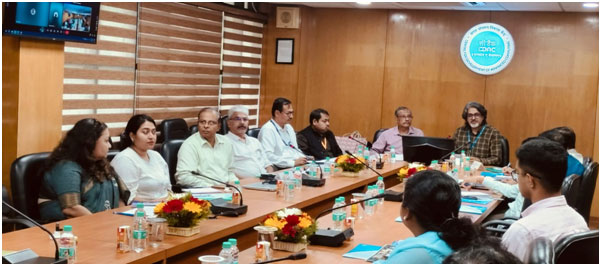
C-DAC, Kolkata, in association with collaborators, IIMCIP Kolkata, CMTI Bengaluru and CFTRI Mysuru organized CPAM-AG&FP Symposium 2026 on Additive Manufacturing on July 17th, 2026 at C-DAC, Kolkata premises. Thissymposium was organized as part of the MeitYsponsored CPAM-Agri & Food Processing (CPAM-AG&FP) programme.The objective of this symposium was exposition of 3D food printing, tech-to-table talk, sustainable farming techniques and future insights on 3D food printing.
The inaugural session was graced virtually by the Chief Guest,Smt. Sunita Verma, Group Coordinator (R&D), MeitY, Government of India. The programme witnessed the esteemed presence of Dr. Sankha dip Das,Scientist E, MeitY, Shri Mrinmoy Kumar Das, Executive Director, C-DAC Kolkata, Prof. Rajib Bandyopadhyay,Chairman,Expert Review Committee (ERC), Dr. Tushar Kanti Behera,Director, ICAR-IIHR, and Shri Ujjwal Mitra, Member, ERC. The event was also attended by distinguished dignitaries, project team members, representatives from academia, industry, nutritionists, dietitians, and other eminent stakeholders from the agriculture, food technology and additive manufacturing ecosystem.
The technical programme was structured to provide participants with practical insights into 3D food printing technology and the advanced agricultural practices being researched and developed at CPAM-AG&FP Centre. The sessions highlighted recent technological advancements, ongoing research initiatives, and their potential applications in promoting innovation, sustainability, and personalized nutrition within the agri-food ecosystem.
The sessions commenced with a presentation by Shri Sabyasachi Majumdar, Senior Project Engineer, C-DAC who provided an overview of the current status and future prospects of various farming techniques, plant growth modelling, and the expansion of the project's product portfolio to include strawberries. This was followed by a presentation from Shri Jitendra Rai, Module Leader, C-DAC who outlined the national and global landscape of 3D food printing, highlighting emerging trends, technological advancements, and future opportunities.
Subsequently, Shri Sunil Magadum,ScientistD, Central Manufacturing Technology Institute (CMTI), Bengaluru, delivered a technical session on the current state of 3D food printing systems, discussing recent developments, capabilities, and future directions of the technology. The session concluded with an insightful presentation by Dr. Pradeep Singh Negi,Chief Scientist, CSIR–Central Food Technological Research Institute (CSIR-CFTRI), Mysuru, who elaborated on the development of food inks, covering formulation strategies, material properties, and their significance in enabling reliable and high-quality 3D food printing. Shri Debapratim Das, CFO, IIMCIP, Kolkata, delivered a session on the commercialization of additive manufacturing. He emphasized a Design Thinking approach to identify real-world, scalable, and commercially viable challenges that additive manufacturing can address, highlighting the importance of translating research into market-ready solutions.
An interactive Q&A session was moderated by Dr. Alokesh Ghosh, ScientistG, C-DACallowing participants to discuss implementation challenges and product related queries. In his remarks, Dr. Sankha dip Dashighlighted that the National Strategy on Additive Manufacturing (NSAM) promotes additive manufacturing across sectors, with food processing identified as a high-potential area. He emphasized collaboration and partnerships to accelerate innovation and commercialization. The symposium concluded withProf. Rajib Bandhopadhyay thanking and inviting all industry, academia and other stakeholders to come forward and join this CPAM initiative.
The programme also featured a live demonstration of two 3D food printers, showcasing the on-site printing of edible sweets. Participants observed the complete printing process, sampled the printed products, and shared their feedback. In parallel, the project team demonstrated the advanced farming techniques being researched and developed at the C-DAC Kolkata campus as part of the project.
The workshop received an enthusiastic response from participating organizations. Key action points identified include strengthening industry–academia collaboration, enhancing produce quality, exploring waste-based raw materials, and developing commercially viable products with defined ROI pathways.